American Pyramid
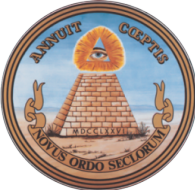
On the Great Seal of the United States is the All Seeing Eye
God?
Another
clue...The only true "cornerstone" of a building
can be the "capstone" of a pyramid. Why? Because
the pyramid is the only structure that can have
all sides connect to one corner. Certainly you
know that Jesus Christ is referred to the
"Cornerstone" of the church. "The cornerstone
the builders rejected." The connection? The USA
is the country God promised would be
formed by the Lost Tribes Of Israel known as the
13th tribes. (This is also why the great seal is
full of the number 13. And why David's Star is
also built into the seal.) For a great beginners
study of this truth I recommend the book below.
For a study
of the Masonic and occult representations in The
Great Seal of America we've found a 3 part very
comprehensive documentary (at right ---->), that
has a chilling final conclusion. We recommend
watching them in full screen mode.
American
Pyramid?
Why is there a pyramid on "The Great Seal Of The United
States"? As far as I know there are not any pyramids in
the United States of America.
So why a depiction of the Great
Pyramid of Giza? The largest pyramid ever built, and
without a capstone on top. What is the connection? Most
will blame the Masonic influence. But the reality is
found in the Bible. Solve the riddle given in Isaiah
19:19 for the first clue. The Giza pyramid has the
entire Biblical history (past, present, and future)
mathematically encoded in its outer and inner (the only
pyramid with passages and chambers inside it)
dimensions.
WHO BUILT THE GREAT PYRAMID OF GIZA?
In part one "Who Built The Great
Pyramid", Joseph A Cortes of Faith Cometh By Hearing
ministries lays out the historical and Biblical evidence
for a very specific and admired Old Testament figure. In
this part 2 video, he will lay out a possible new theory
as to its construction. It will blow your mind!
The all-seeing eye was a
well-known classical symbol of the Renaissance.
The eye in a triangle design originally was
suggested by Pierre Eugene du Simitiere, and
later heraldist William Barton improved upon the
design. In Du Simitiere's original sketch, two
figures stand next to a shield with the
all-seeing pyramid above them. The August 20,
1776 report of the first Great Seal Committee
describes the seal as "Crest The Eye of
Providence in a radiant Triangle whose Glory
extends over the Shield and beyond the Figures."
Abstract
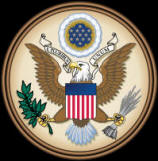
of all elements counting thirteen on
The Great Seal.
In honor of the fact that there were
originally thirteen States in the Union,
items consisting of this number is a
common motif in the seal. There are:
* 13 stars (in the "glory" above the
eagle's head)
* 13 stripes on the shield
* 13 arrows in the eagle’s talon
* 13 letters in the mottos "e pluribus
unum" and "annuit coeptis" (apparently
coincidental; there are 52 letters on
the whole seal, which is itself evenly
divisible by 13)
* 13 olive leaves (by custom, not by
law)
* 13 olives on the branch (by custom,
not by law)
* 13 brick levels of the pyramid (by
custom, not by law)
* 13 sides showing on the ribbon (by
custom, not by law)
The Great
Seal of the United States is used to authenticate
certain documents issued by the United States
government. The phrase is used both for the physical
seal itself (which is kept by the U.S. Secretary of
State), and more generally for the design impressed upon
it. The Great Seal was publicly first used in 1782.
The design on the obverse of the great seal is the
national coat of arms of the United States and is
officially used on documents such as passports as well
as for military insignia, embassy placards, and various
flags. As a coat of arms, the design has official
colors; the physical Great Seal itself, as affixed to
paper, is monochrome.
The 1782 resolution adopting the seal describes the
image on the reverse as "A pyramid unfinished. In the
zenith an eye in a triangle, surrounded by a glory,
proper." The pyramid is conventionally shown as
consisting of thirteen layers of blocks to refer to the
thirteen original states. There are also thirteen sides
shown on the ribbon. The adopting resolution provides
that it is inscribed on its base with the date MDCCLXXVI
(1776) in Roman numerals. Where the top of the pyramid
should be, the Eye of Providence watches over it. Two
mottos appear: Annuit C?ptis signifies that the Eye of
Providence has "approved of (our) undertakings."Novus
Ordo Seclorum, freely taken from Virgil, means "a new
order of the ages". It is incorrectly rendered as "New
World Order" by some theorists, and "a new secular
order" by others. The word seclorum does not mean
"secular", as one might assume, but is the genitive
(possessive) plural form of the word saeculum, meaning
(in this context) generation, century, or age. Saeculum
did come to mean "age, world" in late, Christian, Latin,
and "secular" is derived from it, through secularis.
However, the adjective "secularis," meaning "worldly,"
is not equivalent to the nominative plural possessive "seclorum,"
meaning "of the ages.". The reverse has never been cut
(as a seal) but appears, for example, on the back of the
one-dollar bill.

 Abstract
of all elements counting thirteen on
Abstract
of all elements counting thirteen on